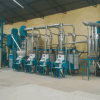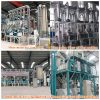
In the food processing industry, flour milling machinery is not only the core tool for transforming raw wheat into finished flour but also a key indicator of advanced processing technology. As market demand grows and consumer expectations for food quality rise, the importance of flour milling equipment has become increasingly evident. This article explores the classifications, functions, and application scenarios of flour milling machinery to help you make informed choices regarding the selection and use of this equipment.
I. What is a Maida Making Machine?
Flour milling machinery refers to the complete set of mechanical equipment used to process raw grains—such as wheat—into various types of flour that meet market demands. It typically comprises the following subsystems:
Cleaning System: Includes equipment such as destoners and magnetic separators, used to remove impurities and foreign objects.
Crushing and Grinding System: Includes multifunctional flour mills and wheat crushers, used to break down and grind grains into powder.
Sifting System: Includes flour sifting equipment, used to separate flour particles of different sizes.
Packaging System: Includes flour packaging machines, used for automated weighing, bagging, and sealing.
Together, these components form a complete flour processing workflow and constitute the core of flour milling plants and equipment systems.
II. Classification and Functions of Flour Milling Machinery
Flour milling machinery comes in a wide variety of types; based on function and application scenarios, they can generally be categorized as follows:
2.1 Fully Automated Wheat Flour Milling Machinery
Suitable for large-scale production lines; integrates processes such as cleaning, grinding, sifting, and packaging to achieve automation, offering ease of operation and high efficiency.
2.2 Semi-Automated Flour Milling Machinery
Suitable for small-to-medium-sized factories or startups; offers some automation capabilities while retaining certain manual operational steps.
2.3 Specialized Flour Milling Machinery
Designed for specific purposes (such as producing high-gluten flour or animal feed); examples include specialized processing units and dedicated bread flour mills, catering to specific production requirements.
2.4 Small-Scale Household Flour Milling Machinery
Suitable for home users; includes compact household flour mills and electric processing units that are simple to operate and convenient for daily use, making them ideal for home baking enthusiasts. III. Why Choose High-Efficiency Flour Milling Equipment?
The performance of flour milling equipment directly impacts output, product quality, and operating costs. Selecting high-performance equipment offers the following advantages:
3.1 Increased Production Efficiency
Utilizing high-efficiency flour processing equipment—such as advanced milling machines—can significantly boost processing efficiency and meet the demands of large-scale production.
3.2 Guaranteed Flour Quality
Advanced flour milling equipment typically features precision sifting systems and accurate temperature control technology, ensuring uniform particle size and consistent quality that meets national standards.
3.3 Reduced Labor Costs
With the widespread adoption of fully automated flour milling equipment, enterprises can reduce their reliance on manual labor, enabling unattended or semi-automated operations and thereby saving on labor costs.
3.4 Energy Efficiency and Environmental Compliance
An increasing number of flour processing facilities are adopting energy-efficient milling machines equipped with eco-friendly dust collection systems; this ensures compliance with environmental production standards and supports the enterprise’s transition to greener operations.
A high-efficiency, stable flour milling system is key to enhancing the competitiveness of modern flour processing plants. Whether opting for fully automated systems or energy-efficient, eco-friendly equipment, selecting the right machinery can significantly improve both processing efficiency and product quality.
You Might Also Want to Know: Wheat Grain Mill Machine Boosts the Development of the Grain Processing Industry