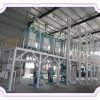
After some time, you should have a basic understanding of the milling machine for wheat flour. However, for customers who want to delve deeper into the subject, this information may not be comprehensive enough. This article will share knowledge about the processing capacity of wheat flour milling equipment to help you understand the equipment more fully and make informed decisions when purchasing and using it.
I. Processing Range and Characteristics of The Wheat Flour Production Line
Processing Range: The 20-30ton wheat milling machine can process various grains that can be ground into powder, such as millet, soybeans, sorghum, wheat, and corn. Basically, any grain that can be ground into flour can be processed.
Equipment Differences: Flour mills lack a separation structure for bran and flour, and can only process grains into powder, unable to separate the husk and flour. Flour mills, on the other hand, are specifically designed for processing wheat and have a separation structure that effectively separates the husk from the flour. Therefore, flour mills are suitable for processing grains like corn and soybeans that do not require separation, but not for processing wheat.
II. Design and Performance of Flour Milling Machinery
Taking the equipment of Hanzhong Burt Machinery Company as an example, its 100-ton mill flour machine adopts a two-stage sieving structure design, combined with a unique flour extraction and grading sieving scheme, improving product quality and production efficiency. The equipment utilizes a circular sieve air-lift process, resulting in significant sieving effects and convenient sieve replacement. These designs reflect the company’s achievements in technological accumulation and innovation, integrating experience and technology to drive the development of flour milling machinery.
III. Maintenance of Wear Parts and Equipment Lifespan
The performance of flour milling machinery is closely related to the wear degree of wear parts. Proper maintenance of wear parts can extend the overall service life of the equipment. The maintenance cycle and methods for different wear parts vary; therefore, after a period of use, wear parts need to be inspected and maintained regularly. Maintenance personnel should carefully inspect the wear condition and replace damaged parts in a timely manner to reduce malfunctions and extend equipment service life.
IV. Equipment Adjustment and Processing Effect
For flour processing enterprises, equipment performance is certainly important, but reasonable adjustments can further improve processing effects. After installation, the adjustment sequence should begin with the grinding rollers, which are key components for flour processing. The distance between the grinding rollers directly affects the fineness of the flour and requires careful adjustment. Secondly, adjust the eccentric sleeve next to the ball screw to ensure the four corners of the plate are flattened, and the eccentric sleeve is fixed, optimizing processing results. Finally, use a feeler gauge to measure the distance between the two rollers and adjust it to the optimal state, thus ensuring processing quality and efficiency.
We hope this information provides practical guidance for the selection and use of the wheat flour making machine.